WHAT IS SKELITAL SYSTEM?
The skeletal system includes all of the bones and joints in the body. Each bone is a complex living organ that is made up of many cells, protein fibers, and minerals. The skeleton acts as a scaffold by providing support and protection for the soft tissues that make up the rest of the body.
The skeletal system works as a support structure for your body. It gives the body its shape, allows movement, makes blood cells, provides protection for organs and stores minerals. The skeletal system is also called the musculoskeletal system.
WHAT IS HUMAN SKELITAL SYSTEM?
The human skeleton is the internal framework of the human body. It is composed of around 270 bones at birth – this total decreases to around 206 bones by adulthood after some bones get fused together. The bone mass in the skeleton reaches maximum density around age 21.
- Bones – rigid structure.
- Cartilage – soft, cushions the joint.
- Ligaments – attach bone to bone.
- Tendon – attach muscle to bone.
WHAT IS THE FUNCTION OF SKELITAL SYSTEM IN HUMAN BODY?
The skeleton serves six major functions: support, movement, protection, production of blood cells, storage of minerals and endocrine regulation.
Protection
- The skull protects the brain.
- The vertebrae protect the spinal cord.
- The rib cage, spine, and sternum protect the lungs, heart and major blood vessels.
WHICH IS THE BIGGEST BONE IN HUMAN SKELITON?
The femurThe femur is the strongest bone in the body, and it is the longest bone in the human body.
HOW BIG IS THE BIGGEST BONE IN HUMAN SKELITON?
The femur is the longest bone found in the human body. It is almost 19.9 inches long and is commonly known as the thigh bone. One can evaluate that femur is the longest bone just by looking at his/her thigh. It runs from the hip down to around the knee area.
WHICH IS THE SMALLEST BONE IN HUMAN SKELITON?
Stapes is ( 3 mm x 2.5 mm ), the “stapes” in the middle ear is the smallest named bone in the human body. The shape of a stirrup, this bone is one of three in the middle ear, collectively known as the ossicles.
WHAT IS THE FUNCTION OF THE SMALLEST BONE IN HUMAN SKELITON?
The stapes bone is essential to our ability to hear. Sounds vibrate the tympanic membrane (the eardrum) and travel through all three bones of the middle ear—the malleus, incus, and stapes.
HUMAN SKELETON
skeleton, Bony framework of the body. It includes the skull, vertebral column, collarbone, shoulder blades, rib cage, pelvic girdle and the bones of the hands, arms, feet, and legs. The skeleton supports the body and protects its internal organs. It is held together by ligaments and moved at the joints by the muscles, which are attached to it. The skeletal system includes both bones and cartilage.
bone, Rigid connective tissue of vertebrates, consisting of cells embedded in a hard matrix. Bones serve as the body’s supporting framework, provide muscle-attachment points for movement, protect the internal organs, house the blood-cell formation system (red bone marrow), and hold about 99% of the calcium vital to many body processes. Bone consists of a matrix of crystals of calcium, chiefly the phosphate and carbonate, embedded among collagen fibres, providing strength and elasticity, and bone cells (less than 5% of its volume). An external layer of compact bone surrounds a central area of spongy bone, except at the marrow cavity. Bone does not grow by cell division; instead, different types of bone cells generate bone matrix, break it down, and maintain it. Bone is remodeled by this process, which strengthens it in areas under greatest stress, permits healing of fractures, and helps regulate calcium levels in body fluid (see calcium deficiency). The process also causes underutilized bone, as in an immobilized limb, to atrophy. Bone disorders include rheumatoid arthritis, osteoarthritis, rickets, osteoporosis, and tumours. Bone can fracture suddenly or over time, as in stress fractures.
cell, in biology, the basic membrane-bound unit that contains the fundamental molecules of life and of which all living things are composed. A single cell is often a complete organism in itself, such as a bacterium or yeast. Other cells acquire specialized functions as they mature. These cells cooperate with other specialized cells and become the building blocks of large multicellular organisms, such as humans and other animals. Although cells are much larger than atoms, they are still very small. The smallest known cells are a group of tiny bacteria called mycoplasmas; some of these single-celled organisms are spheres as small as 0.2 μm in diameter (1μm = about 0.000039 inch), with a total mass of 10−14 gram—equal to that of 8,000,000,000 hydrogen atoms. Cells of humans typically have a mass 400,000 times larger than the mass of a single mycoplasma bacterium, but even human cells are only about 20 μm across. It would require a sheet of about 10,000 human cells to cover the head of a pin, and each human organism is composed of more than 30,000,000,000,000 cells.
osteocyte, a cell that lies within the substance of fully formed bone. It occupies a small chamber called a lacuna, which is contained in the calcified matrix of bone. Osteocytes derive from osteoblasts, or bone-forming cells, and are essentially osteoblasts surrounded by the products they secreted. Cytoplasmic processes of the osteocyte extend away from the cell toward other osteocytes in small channels called canaliculi. By means of these canaliculi, nutrients and waste products are exchanged to maintain the viability of the osteocyte. Osteocytes are the most abundant type of cell in mature bone tissue. They also are long-lived, surviving as long as the bone they occupy exists.
osteoblast, large cell responsible for the synthesis and mineralization of bone during both initial bone formation and later bone remodeling. Osteoblasts form a closely packed sheet on the surface of the bone, from which cellular processes extend through the developing bone. They arise from the differentiation of osteogenic cells in the periosteum, the tissue that covers the outer surface of the bone, and in the endosteum of the marrow cavity. This cell differentiation requires a regular supply of blood, without which cartilage-forming chondroblasts, rather than osteoblasts, are formed. The osteoblasts produce many cell products, including the enzymes alkaline phosphatase and collagenase, growth factors, hormones such as osteocalcin, and collagen, part of the organic unmineralized component of the bone called osteoid. Eventually the osteoblast is surrounded by the growing bone matrix, and, as the material calcifies, the cell is trapped in a space called a lacuna. Thus entrapped, it becomes an osteocyte, or bone cell. Osteocytes communicate with each other as well as with free bone surfaces via extensive cytoplasmic processes that occupy long, meandering channels (canaliculi) through the bone matrix.
————————————————————————————————
skull, skeletal framework of the head of vertebrates, composed of bones or cartilage, which form a unit that protects the brain and some sense organs. The upper jaw, but not the lower, is part of the skull. The human cranium, the part that contains the brain, is globular and relatively large in comparison with the face. In most other animals the facial portion of the skull, including the upper teeth and the nose, is larger than the cranium. In humans the skull is supported by the highest vertebra, called the atlas, permitting nodding motion. The atlas turns on the next-lower vertebra, the axis, to allow for side-to-side motion.
jaw, either of a pair of bones that form the framework of the mouth of vertebrate animals, usually containing teeth and including a movable lower jaw (mandible) and fixed upper jaw (maxilla). Jaws function by moving in opposition to each other and are used for biting, chewing, and the handling of food. The mandible consists of a horizontal arch, which holds the teeth and contains blood vessels and nerves. Two vertical portions (rami) form movable hinge joints on either side of the head, articulating with the glenoid cavity of the temporal bone of the skull. The rami also provide attachment for muscles important in chewing. The centre front of the arch is thickened and buttressed to form a chin, a development unique to man and some of his recent ancestors; the great apes and other animals lack chins.
vertebral column, or spinal column or spine or backbone, Flexible column extending the length of the torso. In humans, it consists of 32–34 vertebrae, with different shapes and functions in each of five regions: 7 cervical, in the neck (including the atlas and axis, modified for free movement of the skull); 12 thoracic, in the chest; 5 lumbar, in the lower back; 5 sacral (fused into the sacrum, part of the pelvic girdle); and 3 to 5 coccygeal (vestigial tailbones fused into the coccyx). The body of each vertebra is separated from its neighbours by cushioning intervertebral disks of cartilage. Behind the body is a Y-shaped vertebral (neural) arch with structures extending up and down to form joints with the adjacent vertebrae and to the back and sides to provide attachment points for muscles and ligaments. The spine supports the torso and protects the spinal cord.
scapula, also called shoulder blade, either of two large bones of the shoulder girdle in vertebrates. In humans they are triangular and lie on the upper back between the levels of the second and eighth ribs. A scapula’s posterior surface is crossed obliquely by a prominent ridge, the spine, which divides the bone into two concave areas, the supraspinous and infraspinous fossae. The spine and fossae give attachment to muscles that act in rotating the arm. The spine ends in the acromion, a process that articulates with the clavicle, or collarbone, in front and helps form the upper part of the shoulder socket. The lateral apex of the triangle is broadened and presents a shallow cavity, the glenoid cavity, which articulates with the head of the bone of the upper arm, the humerus, to form the shoulder joint. Overhanging the glenoid cavity is a beaklike projection, the coracoid process, which completes the shoulder socket. To the margins of the scapula are attached muscles that aid in moving or fixing the shoulder as demanded by movements of the upper limb.
periosteum, dense fibrous membrane covering the surfaces of bones, consisting of an outer fibrous layer and an inner cellular layer (cambium). The outer layer is composed mostly of collagen and contains nerve fibres that cause pain when the tissue is damaged. It also contains many blood vessels, branches of which penetrate the bone to supply the osteocytes, or bone cells. These perpendicular branches pass into the bone along channels known as Volkmann canals to the vessels in the haversian canals, which run the length of the bone. Fibres from the inner layer also penetrate the underlying bone, serving with the blood vessels to bind the periosteum to the bone as Sharpey fibres.
————————————————————————————————
bone formation, also called ossification, process by which new bone is produced. Ossification begins about the third month of fetal life in humans and is completed by late adolescence. The process takes two general forms, one for compact bone, which makes up roughly 80 percent of the skeleton, and the other for cancellous bone, including parts of the skull, the shoulder blades, and the ends of the long bones.
cancellous bone, also called trabecular bone or spongy bone, light, porous bone enclosing numerous large spaces that give a honeycombed or spongy appearance. The bone matrix, or framework, is organized into a three-dimensional latticework of bony processes, called trabeculae, arranged along lines of stress. The spaces between are often filled with marrow and blood vessels. Cancellous bone makes up about 20 percent of the human skeleton, providing structural support and flexibility without the weight of compact bone. It is found in most areas of bone that are not subject to great mechanical stress. It makes up much of the enlarged ends (epiphyses) of the long bones and is the major component of the ribs, the shoulder blades, the flat bones of the skull, and a variety of short, flat bones elsewhere in the skeleton. Cancellous bone is usually surrounded by a shell of compact bone, which provides greater strength and rigidity. The open structure of cancellous bone enables it to dampen sudden stresses, as in load transmission through the joints. Varying proportions of space to bone are found in different bones according to the need for strength or flexibility. Cancellous bone also has a relatively high level of metabolic activity.Cancellous bone can develop into compact bone through the action of bone-forming cells called osteoblasts. It is in that manner that all long bones develop in the embryo. The osteoblasts deposit new bone matrix in layers around the trabeculae, which thus enlarge at the expense of the spaces between them. Eventually the spaces are eliminated, and immature compact bone is produced.
————————————————————————————————
EMBRYONIC SKELETON
Bone of the first type begins in the embryonic skeleton with a cartilage model, which is gradually replaced by bone. Specialized connective tissue cells called osteoblasts secrete a matrix material called osteoid, a gelatinous substance made up of collagen, a fibrous protein, and mucopolysaccharide, an organic glue. Soon after the osteoid is laid down, inorganic salts are deposited in it to form the hardened material recognized as mineralized bone. The cartilage cells die out and are replaced by osteoblasts clustered in ossification centres. Bone formation proceeds outward from these centres. This replacement of cartilage by bone is known as endochondral ossification. Most short bones have a single ossification centre near the middle of the bone; long bones of the arms and legs typically have three, one at the centre of the bone and one at each end. Ossification of long bones proceeds until only a thin strip of cartilage remains at either end; this cartilage, called the epiphyseal plate, persists until the bone reaches its full adult length and is then replaced with bone.
clavicle, also called collarbone, curved anterior bone of the shoulder (pectoral) girdle in vertebrates; it functions as a strut to support the shoulder. The clavicle is present in mammals with prehensile forelimbs and in bats, and it is absent in sea mammals and those adapted for running. The wishbone, or furcula, of birds is composed of the two fused clavicles; a crescent-shaped clavicle is present under the pectoral fin of some fish. In humans the two clavicles, on either side of the anterior base of the neck, are horizontal, S-curved rods that articulate laterally with the outer end of the shoulder blade (the acromion) to help form the shoulder joint; they articulate medially with the breastbone (sternum). Strong ligaments hold the clavicle in place at either end; the shaft gives attachment to muscles of the shoulder girdle and neck.
ear bone, also called Auditory Ossicle, any of the three tiny bones in the middle ear of all mammals. These are the malleus, or hammer, the incus, or anvil, and the stapes, or stirrup. Together they form a short chain that crosses the middle ear and transmits vibrations caused by sound waves from the eardrum membrane to the liquid of the inner ear. The malleus resembles a club more than a hammer, whereas the incus looks like a premolar tooth with an extensive root system. The stapes does closely resemble a stirrup. The top or head of the malleus and the body of the incus are held together by a tightly fitting joint and are seated in the attic, or upper portion, of the eardrum cavity. The handle of the malleus adheres to the upper half of the drum membrane. Three small ligaments hold the head of the malleus, and a fourth attaches a projection (called the short process) from the incus to a slight depression in the back wall of the cavity. The long process of the incus is bent near the lower end and carries a small knoblike bone that is jointed loosely to the head of the stapes—the third and smallest of the ossicles. The stapes lies in a horizontal position at right angles with the long process of the incus. There are two openings in the wall of the bony labyrinth and the stapes footplate fits perfectly in one of these openings—an oval-shaped window, where it is held in place by yet another ligament called the annular ligament. There are two tiny muscles in the middle ear, which serve to alter the tension on the ear bones and thus the intensity (degree of loudness) of sounds. One, the tensor tympani, is attached to the handle of the malleus (itself attached to the eardrum membrane) and by its contraction tends to draw the malleus inward, thus increasing drum membrane tension. The second, called stapedius, tends to pull the footplate of the stapes out of the oval window. This is accomplished by tipping the stirrup, or stapes, backward.
osteoclast, large multinucleated cell responsible for the dissolution and absorption of bone. Bone is a dynamic tissue that is continuously being broken down and restructured in response to such influences as structural stress and the body’s requirement for calcium. The osteoclasts are the mediators of the continuous destruction of bone. Osteoclasts occupy small depressions on the bone’s surface, called Howship lacunae; the lacunae are thought to be caused by erosion of the bone by the osteoclasts’ enzymes. Osteoclasts are formed by the fusion of many cells derived from circulating monocytes in the blood. These in turn are derived from the bone marrow. Osteoclasts may have as many as 200 nuclei, although most have only 5 to 20. The side of the cell closest to the bone contains many small projections (microvilli) that extend into the bone’s surface, forming a ruffled, or brush, border that is the cell’s active region. Osteoclasts produce a number of enzymes, chief among them acid phosphatase, that dissolve both the organic collagen and the inorganic calcium and phosphorus of the bone. Mineralized bone is first broken into fragments; the osteoclast then engulfs the fragments and digests them within cytoplasmic vacuoles. Calcium and phosphorus liberated by the breakdown of the mineralized bone are released into the bloodstream. Unmineralized bone (osteoid) is protected against osteoclastic resorption.
————————————————————————————————
HANDS
carpal bone, any of several small angular bones that in humans make up the wrist (carpus), and in horses, cows, and other quadrupeds the “knee” of the foreleg. They correspond to the tarsal bones of the rear or lower limb. Their number varies. Primitive vertebrates typically had 12. In modern amphibians, reptiles, and birds, the number is reduced by fusion. In humans there are eight, arranged in two rows. The bones in the row toward the forearm are the scaphoid, lunate, triangular, and pisiform. The row toward the fingers, or distal row, includes the trapezium (greater multangular), trapezoid (lesser multangular), capitate, and hamate. The distal row is firmly attached to the metacarpal bones of the hand. The proximal row articulates with the radius (of the forearm) and the articular disk (a fibrous structure between the carpals and malleolus of the ulna) to form the wrist joint.
elbow, in human anatomy, hinge joint formed by the meeting of the humerus (bone of the upper arm) and the radius and ulna (bones of the forearm). The elbow allows the bending and extension of the forearm, and it also allows the rotational movements of the radius and ulna that enable the palm of the hand to be turned upward or downward. The elbow forms from the expansion of the lower end of the humerus into two thick knobs, or condyles: the humerus’ dome-shaped lateral condyle articulates with a shallow depression on the end of the radius, and the humerus’ spool-shaped trochlea fits into a notch in the ulna. In addition, the edge of the radius’ head fits into a shallow groove on the side of the ulna. The bending and extension of the elbow joint are achieved, respectively, by contractions of the biceps and triceps muscles. These movements chiefly involve only the humerus and ulna; rotation of the forearm involves the smaller radius bone as well.
wrist, also called carpus, complex joint between the five metacarpal bones of the hand and the radius and ulna bones of the forearm. The wrist is composed of eight or nine small, short bones (carpal bones) roughly arranged in two rows. The wrist is also made up of several component joints: the distal radioulnar joint, which acts as a pivot for the forearm bones; the radiocarpal joint, between the radius and the first row of carpal bones, involved in wrist flexion and extension; the midcarpal joint, between two of the rows of carpal bones; and various intercarpal joints, between adjacent carpal bones within the rows. The numerous bones and their complex articulations give the wrist its flexibility and wide range of motion. A disk of fibrous cartilage between the radius and the ulna separates the radioulnar joint from the rest of the wrist, which is contained within a capsule of cartilage, synovial membrane, and ligaments. Radiocarpal ligaments carry the hand along with the forearm in rotational movements, and intercarpal ligaments strengthen the small wristbones.
arm, in zoology, either of the forelimbs or upper limbs of ordinarily bipedal vertebrates, particularly humans and other primates. The term is sometimes restricted to the proximal part, from shoulder to elbow (the distal part is then called the forearm). In brachiating (tree-swinging) primates the arm is unusually long.
hand, grasping organ at the end of the forelimb of certain vertebrates that exhibits great mobility and flexibility in the digits and in the whole organ. It is made up of the wrist joint, the carpal bones, the metacarpal bones, and the phalanges. The digits include a medial thumb (when viewed with the palm down), containing two phalanges, and four fingers, each containing three phalanges. {The major function of the hand in all vertebrates except human beings is locomotion; bipedal locomotion in humans frees the hands for a largely manipulative function. In primates the tips of the fingers are covered by fingernails—a specialization that improves manipulation. The palms and undersides of the fingers are marked by creases and covered by ridges called palm prints and fingerprints, which function to improve tactile sensitivity and grip. The friction ridges are arranged in general patterns that are peculiar to each species but that differ in detail. No two individuals are alike, and in humans the patterns are used for identification. The thumb is usually set at an angle distinct from the other digits; in humans and the great apes it rotates at the carpometacarpal joint, and it is therefore opposable to the other fingers and may be used in combination with them to pick up small objects.}
metacarpal, any of several tubular bones between the wrist (carpal) bones and each of the forelimb digits in land vertebrates, corresponding to the metatarsal bones of the foot. Originally numbering five, metacarpals in many mammals have undergone much change and reduction during evolution. The lower leg of the horse, for example, includes only one strengthened metacarpal; the two splint bones behind and above the hoof are reduced metacarpals, and the remaining two original metacarpals have been lost. In humans the five metacarpals are flat at the back of the hand and bowed on the palmar side; they form a longitudinal arch that accommodates the muscles, tendons, and nerves of the palm. The metacarpals also form a transverse arch that allows the fingertips and thumb to be brought together for manipulation.
carpal bone, any of several small angular bones that in humans make up the wrist (carpus), and in horses, cows, and other quadrupeds the “knee” of the foreleg. They correspond to the tarsal bones of the rear or lower limb. Their number varies. Primitive vertebrates typically had 12. In modern amphibians, reptiles, and birds, the number is reduced by fusion. In humans there are eight, arranged in two rows. The bones in the row toward the forearm are the scaphoid, lunate, triangular, and pisiform. The row toward the fingers, or distal row, includes the trapezium (greater multangular), trapezoid (lesser multangular), capitate, and hamate. The distal row is firmly attached to the metacarpal bones of the hand. The proximal row articulates with the radius (of the forearm) and the articular disk (a fibrous structure between the carpals and malleolus of the ulna) to form the wrist joint.
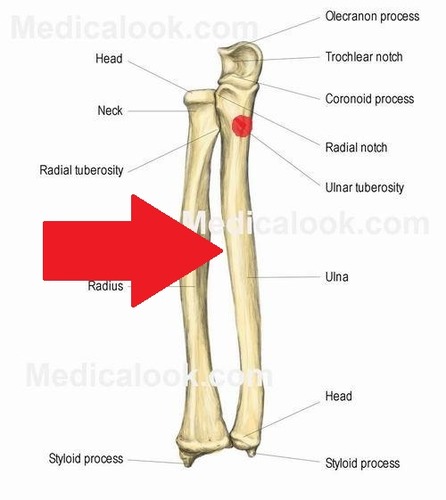
radius, in anatomy, the outer of the two bones of the forearm when viewed with the palm facing forward. All land vertebrates have this bone. In humans it is shorter than the other bone of the forearm, the ulna. The head of the radius is disk-shaped; its upper concave surface articulates with the humerus (upper arm bone) above, and the side surface articulates with the ulna. On the upper part of the shaft is a rough projection, the radial tuberosity, which receives the biceps tendon. A ridge, the interosseous border, extends the length of the shaft and provides attachment for the interosseous membrane connecting the radius and the ulna. The projection on the lower end of the radius, the styloid process, may be felt on the outside of the wrist where it joins the hand. The inside surface of this process presents the U-shaped ulnar notch in which the ulna articulates. Here the radius moves around and crosses the ulna as the hand is turned to cause the palm to face backward (pronation).
ulna, inner of two bones of the forearm when viewed with the palm facing forward. (The other, shorter bone of the forearm is the radius.) The upper end of the ulna presents a large C-shaped notch—the semilunar, or trochlear, notch—which articulates with the trochlea of the humerus (upper arm bone) to form the elbow joint. The projection that forms the upper border of this notch is called the olecranon process; it articulates behind the humerus in the olecranon fossa and may be felt as the point of the elbow. The projection that forms the lower border of the trochlear notch, the coronoid process, enters the coronoid fossa of the humerus when the elbow is flexed. On the outer side is the radial notch, which articulates with the head of the radius. The head of the bone is elsewhere roughened for muscle attachment. The shaft is triangular in cross section; an interosseous ridge extends its length and provides attachment for the interosseous membrane connecting the ulna and the radius. The lower end of the bone presents a small cylindrical head that articulates with the radius at the side and the wrist bones below. Also at the lower end is a styloid process, medially, that articulates with a disk between it and the cuneiform (os triquetrum) wrist bone. The ulna is present in all land vertebrates. In amphibians and some reptiles the radius and ulna do not articulate. The elbow joint evolved first among birds and mammals. The radius tends to be slender in birds; but the ulna is more often reduced in mammals, especially in those adapted for running and, in the case of bats, flying.
The olecranon fossa is a deep triangular depression on the posterior side of the humerus, superior to the trochlea. It provides space for the olecranon of the ulna during extension of the forearm.
The coronoid fossa is a hollow on the anterior surface of the distal end of the humerus, just above the trochlea, in which the coronoid process of the ulna rests when the elbow is flexed.
——————————————————————————————–
LEGS
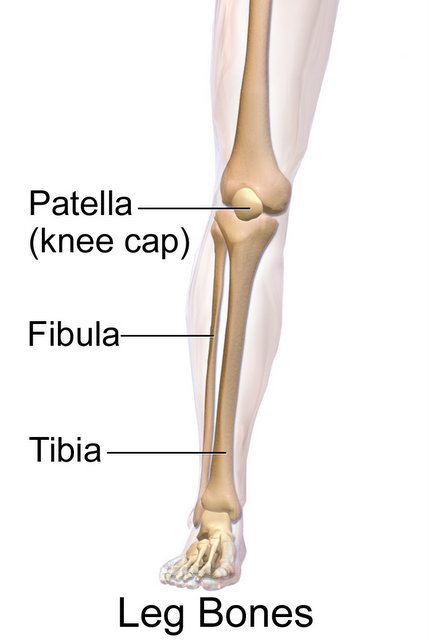
tibia, also called shin, inner and larger of the two bones of the lower leg in vertebrates—the other is the fibula. In humans the tibia forms the lower half of the knee joint above and the inner protuberance of the ankle below. The upper part consists of two fairly flat-topped prominences, or condyles, that articulate with the condyles of the thighbone, or femur, above. The attachment of the ligament of the kneecap, or patella, to the tibial tuberosity in front completes the knee joint. The lateral condyle is larger and includes the point at which the fibula articulates. The tibia’s shaft is approximately triangular in cross section; its markings are influenced by the strength of the attached muscles. It is attached to the fibula throughout its length by an interosseous membrane. At the lower end of the tibia there is a medial extension (the medial malleolus), which forms part of the ankle joint and articulates with the talus (anklebone) below; there is also a fibular notch, which meets the lower end of the shaft of the fibula.
The tibia and fibula are the two long bones in the lower leg. They connect the knee and ankle, but they are separate bones.
ankle, in humans, hinge-type, freely moving synovial joint between the foot and leg. The ankle contains seven tarsal bones that articulate (connect) with each other, with the metatarsal bones of the foot, and with the bones of the lower leg. The articulation of one of the tarsal bones, the ankle bone (talus, or astragalus), with the fibula and tibia of the lower leg forms the actual ankle joint, although the general region is often called the ankle. The chief motions of the ankle are flexion and extension. Like other synovial joints (those joints in which fluid is present), the ankle is subject to such diseases and injuries as bursitis and synovitis.
tarsal, any of several short, angular bones that in humans make up the ankle and that—in animals that walk on their toes (e.g., dogs, cats) or on hoofs—are contained in the hock, lifted off the ground. The tarsals correspond to the carpal bones of the upper limb. In humans the tarsals, in combination with the metatarsal bones, form a longitudinal arch in the foot—a shape well adapted for carrying and transferring weight in bipedal locomotion. In the human ankle there are seven tarsal bones. The talus (astragalus) articulates above with the bones of the lower leg to form the ankle joint. The other six tarsals, tightly bound together by ligaments below the talus, function as a strong weight-bearing platform. The calcaneus, or heel bone, is the largest tarsal and forms the prominence at the back of the foot. The remaining tarsals include the navicular, cuboid, and three cuneiforms. The cuboid and cuneiforms adjoin the metatarsal bones in a firm, nearly immovable joint.
metatarsal, any of several tubular bones between the ankle (tarsal) bones and each of the hindlimb digits, in land vertebrates corresponding to the metacarpal bones of the hand (forepaw). In humans the five metatarsal bones help form longitudinal arches along the inner and outer sides of the foot and a transverse arch at the ball of the foot. The first metatarsal (which adjoins the phalanges of the big toe) is enlarged and strengthened for its weight-bearing function in standing and walking on two feet.
foot, plural feet, in anatomy, terminal part of the leg of a land vertebrate, on which the creature stands. In most two-footed and many four-footed animals, the foot consists of all structures below the ankle joint: heel, arch, digits, and contained bones such as tarsals, metatarsals, and phalanges; in mammals that walk on their toes and in hoofed mammals, it includes the terminal parts of one or more digits.
The major function of the foot in land vertebrates is locomotion. Three types of foot posture exist in mammals: (1) plantigrade, in which the surface of the whole foot touches the ground during locomotion (e.g., human, baboon, and bear), (2) digitigrade, in which only the phalanges (toes and fingers) touch the ground, while the ankle and wrist are elevated (e.g., dog and cat), and (3) unguligrade, in which only a hoof (the tip of one or two digits) touches the ground—a specialization of running animals (e.g., horse and deer).
The human foot is non prehensile and is adapted for a form of bipedalism distinguished by the development of the stride—a long step, during which one leg is behind the vertical axis of the backbone—which allows great distances to be covered with a minimum expenditure of energy. The big toe converges with the others and is held in place by strong ligaments. Its phalanges and metatarsal bones are large and strong. Together, the tarsal and metatarsal bones of the foot form a longitudinal arch, which absorbs shock in walking; a transverse arch, across the metatarsals, also helps distribute weight. The heel bone helps support the longitudinal foot arch.
————————————————————————————————
hip, in anatomy, the joint between the thighbone (femur) and the pelvis; also the area adjacent to this joint. The hip joint is a ball-and-socket joint; the round head of the femur rests in a cavity (the acetabulum) that allows free rotation of the limb. Amphibians and reptiles have relatively weak pelvic girdles, and the femur extends horizontally. This does not permit efficient resistance to gravity, and the trunks of these animals often rest partially on the ground. In mammals the hip joint allows the femur to drop vertically, thus permitting the animal to hold itself off the ground and leading to specializations for running and leaping.
pelvis, also called bony pelvis or pelvic girdle, in human anatomy, basin-shaped complex of bones that connects the trunk and the legs, supports and balances the trunk, and contains and supports the intestines, the urinary bladder, and the internal sex organs.
———————————————————————————————–
Phalanges:
The bones of the fingers and of the toes. There are generally three phalanges (distal, middle, proximal) for each digit except the thumbs and large toes. The singular of phalanges is phalanx.
Long bones are mostly located in the appendicular skeleton and include bones in the lower limbs (the tibia, fibula, femur, metatarsals, and phalanges) and bones in the upper limbs (the humerus, radius, ulna, metacarpals, and phalanges).
 Biology