HOME
Internal Organs
1. Brain
2. Heart
3. Lungs
4. Kidney
5. Pancreas
6. Liver
7. Stomach
8. Intestines
9. Pituitary gland
10. Blood
External Organs
1. Eye
2. Ear
3. Nose
4. Tongue
5. Teeth
6. Bone
7. Skin
8. Hair
9. Nails
Brain
What is the definition of brain?
The brain is a complex organ that controls thought, memory, emotion, touch, motor skills, vision, breathing, temperature, hunger and every process that regulates our body. Together, the brain and spinal cord that extends from it make up the central nervous system, or CNS.
What are the 3 types of the brain?
The brain can be divided into three basic units: the forebrain, the midbrain, and the hindbrain. The hindbrain includes the upper part of the spinal cord, the brain stem, and a wrinkled ball of tissue called the cerebellum. The hindbrain controls the body’s vital functions such as respiration and heart rate.
What does our brain do?
The brain controls what you think and feel, how you learn and remember, and the way you move and talk. But it also controls things you’re less aware of — like the beating of your heart and the digestion of your food. Think of the brain as a central computer that controls all the body’s functions.
What are the main parts of human brain?
The brain has three main parts: the cerebrum, cerebellum and brainstem.
What is brain and its parts?
The cerebrum is further divided into four sections or lobes: Frontal lobe: It is associated with parts of speech, planning, reasoning, problem-solving and movements. Parietal lobe: Help in movements, the perception of stimuli and orientation. Occipital lobe: It is related to visual processing.
What is the study of the brain?
Neuroscience, also known as Neural Science, is the study of how the nervous system develops, its structure, and what it does. Neuroscientists focus on the brain and its impact on behavior and cognitive functions.
What is the unit of brain?
The basic unit of the brain is the neuron.
Where is brain located?
skull
The brain is housed inside the bony covering called the cranium. The cranium protects the brain from injury. Together, the cranium and bones that protect the face are called the skull. Between the skull and brain is the meninges, which consist of three layers of tissue that cover and protect the brain and spinal cord.
What is brain made of?
The human brain is primarily composed of neurons, glial cells, neural stem cells, and blood vessels. Types of neuron include interneurons, pyramidal cells including Betz cells, motor neurons (upper and lower motor neurons), and cerebellar Purkinje cells.
What size is my brain?
about 5.5 x 6.5 x 3.6 inches
On average, the human brain measures about 5.5 x 6.5 x 3.6 inches (140 x 167 x 93 mm). It weighs about 3 pounds (1.3 kg).
What is the largest part of the brain?
The cerebrum is the largest component, extending across the top of the head down to ear level. The cerebellum is smaller than the cerebrum and located underneath it, behind the ears toward the back of the head.
What is the biggest part of the brain?
Your cerebrum is the largest part of your brain, and it handles a wide range of responsibilities. Located at the front and top of your skull, it gets its name from the Latin word meaning “brain.” Your cerebrum is instrumental in everything you do in day-to-day life, ranging from thoughts to actions.
What are the 4 major of the brain?
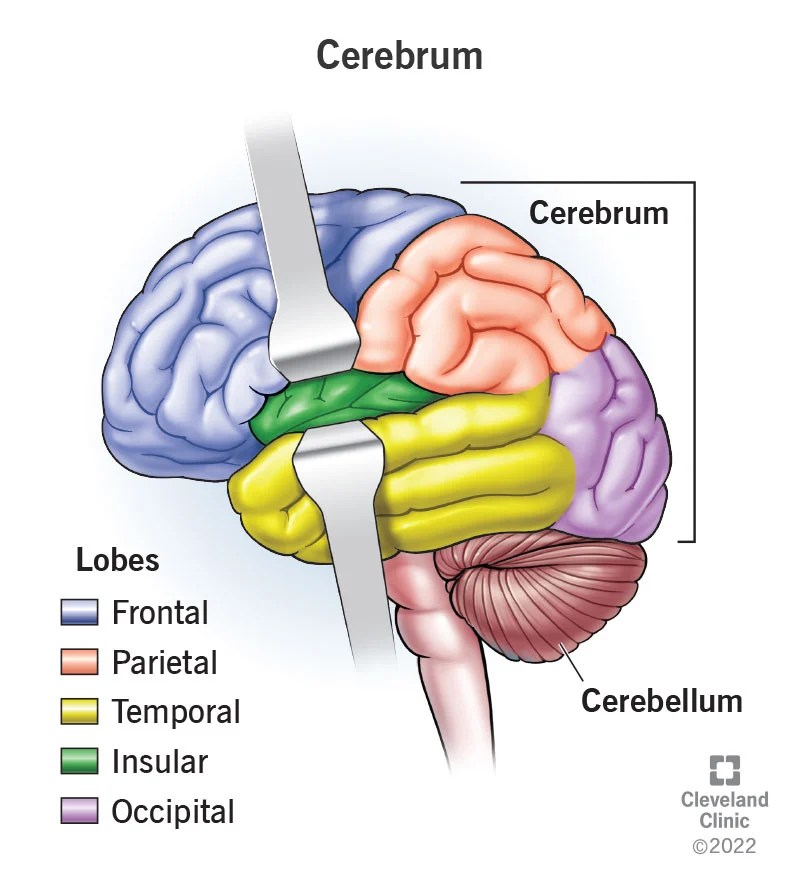
Traditionally, each of the hemispheres has been divided into four lobes: frontal, parietal, temporal and occipital.
What part of the brain is balance?
Cerebellum
Cerebellum. The cerebellum sits at the back of the brain and controls your sense of balance. This allows you to stand up, walk in a straight line, and know if you are standing up or sitting down.
What is a brain type 2?
Brain Type 2 — Spontaneous
The Spontaneous Brain Type tends to be creative, out-of-the-box thinkers who would rather do things on the spur of the moment than have a set schedule. You may struggle with a short attention span, distractibility, disorganization, and impulse control problems.
What are 5 main parts of the brain?
We’re going to talk about these five parts, which are key players on the brain team:
- cerebrum (say: suh-REE-brum)
- cerebellum (say: sair-uh-BELL-um)
- brain stem.
- pituitary (say: puh-TOO-uh-ter-ee) gland.
- hypothalamus (say: hy-po-THAL-uh-mus)
What part of the brain is balance?
Cerebellum
Cerebellum. The cerebellum sits at the back of the brain and controls your sense of balance. This allows you to stand up, walk in a straight line, and know if you are standing up or sitting down.
What is the center of the brain called?
Brainstem. This is the middle of the brain. It includes the midbrain, the pons, and the medulla. The brainstem controls movement of the eyes, face, and mouth.
What is disorder of the brain?
Brain disease affects millions worldwide and includes a wide spectrum of diseases and disorders—from stroke and Alzheimer’s to multiple sclerosis, epilepsy, traumatic brain injury, and more.
What is brain scientist?
Cognitive psychologists, sometimes called brain scientists, study how the human brain works — how we think, remember and learn. They apply psychological science to understand how we perceive events and make decisions.
How is the human brain designed?
Brains are built over time, from the bottom up.
The basic architecture of the brain is constructed through an ongoing process that begins before birth and continues into adulthood. Simpler neural connections and skills form first, followed by more complex circuits and skills.
Why study the brain?
Unravelling how the brain works will help us understand the basis of human behaviour and actions. While each brain is unique, all healthy human brains share the same basic structures and functions.
Who studies brain diseases?
neurologist
A neurologist is a medical doctor who diagnoses, treats and manages disorders of the brain and nervous system (brain, spinal cord and nerves). A neurologist knows the anatomy, function and conditions that affect your nerves and nervous system. Your nervous system is your body’s command center.
Who is called small brain?
Cerebellum, commonly known as the “little brain” because it resembles a miniature cerebrum, is in charge of balance, movement, and coordination. The cerebellum is a brain region that lies underneath the occipital and temporal lobes of the cerebral cortex.
What protects the brain?
The brain is protected by the bones of the skull and by a covering of three thin membranes called meninges. The brain is also cushioned and protected by cerebrospinal fluid. This watery fluid is produced by special cells in the four hollow spaces in the brain, called ventricles.
What is the smallest of the brain?
Situated just below the thalamus, the hypothalamus is the smallest part of the brain. It plays an important role in the nervous system as well as in the endocrine system. It maintains homeostasis, regulates release of hormones and regulates body temperature.
Which side brain is present?
The brain is divided into symmetrical left and right hemispheres. Each hemisphere is in charge of the opposite side of the body, so your right brain controls your left hand. The right hemisphere also takes in sensory input from your left side and vice versa. The brain is segmented into regions called lobes.
What is brain activity?
Defining Functional Brain Activity
Function can be defined as the ability to perform a given cognitive or physiological task.
Which side of the brain works?
The brain’s left half is primarily responsible for speech and abstract thinking. It also controls the right side of the body. The right side of the brain is responsible for image processing, spatial thinking, and movement in the left side of the body.1
Does brain work 24 hours?
How many hours does the brain work? Brain works 24*7*365 days. The only difference is, it works in different levels- conscious, subconscious & unconscious level. The moment your brain stops working, doctors will declare you brain dead or simply dead.
How powerful is the brain?
The human brain can generate about 23 watts of power (enough to power a lightbulb). All that power calls for some much-needed rest. Adequate sleep helps maintain the pathways in your brain. Additionally, sleep deprivation can increase the build-up of a protein in your brain that is linked to Alzheimer’s disease.
What does the brain eat?
The brain needs energy to work, and its main source of energy is glucose. This simple sugar, found in many foods, is carried in the bloodstream and converted into energy by tissue cells throughout the body.
How many kg is the brain?
about 1.4 kilograms
The human brain weighs approximately about 1.4 kilograms and makes up about 2% of the human body weight. The brain is divided into three regions – Forebrain, midbrain, and hindbrain. The forebrain includes the cerebrum, hypothalamus, and thalamus.
Why are brains different?
Some of this variability in the brain—which correlates with differences in personality, cognitive functions, and susceptibility to various neurological and psychiatric syndromes—is accounted for by genetic differences.
Does blood go to the brain?
The brain receives blood from two sources: the internal carotid arteries, which arise at the point in the neck where the common carotid arteries bifurcate, and the vertebral arteries (Figure 1.20). The internal carotid arteries branch to form two major cerebral arteries, the anterior and middle cerebral arteries.
Does my brain have a limit?
The human mind does have a memory limit. The average adult human brain’s memory capacity is 2.5 million gigabytes. However, it doesn’t run out of storage capacity, per se. A single human brain has many different kinds of memories.
How much oxygen does the brain use?
20%
With the average human brain weighing 1400 g (∼2% of total body weight), it therefore consumes ∼49 ml O2 per minute, or 20% of total body oxygen consumed while at rest (21a, 46, 82) (Table 1). Within the brain, oxygen consumption is highly dynamic and region specific.
www.brainfacts.org (Number of Neurons in Brain of a Human Being)
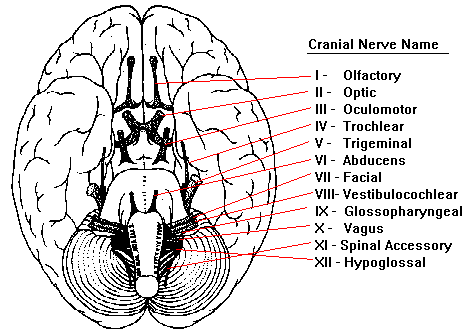
You have 12 cranial nerve pairs. Each nerve pair splits to serve the two sides of your brain and body. For example, you have one pair of olfactory nerves. One olfactory nerve is on the left side of your brain and one is on the right side of your brain.
What are the 4 types of nerves?
It is conventional, however, to describe nerve types on the basis of their function: motor, sensory, autonomic or cranial.
- Motor Nerves. …
- Sensory Nerves. …
- Autonomic Nerves. …
- Cranial Nerves.
- The olfactory nerve
- The olfactory nerve is the first cranial nerve and is instrumental in our sense of smell. The olfactory nerve contains only afferent sensory nerve fibers and, like all cranial nerves, is paired.
- The central nervous system (defined as the brain and spinal cord) is usually considered to have seven basic parts: the spinal cord, the medulla, the pons, the cerebellum, the midbrain, the diencephalon, and the cerebral hemispheres
Which nerve is faster?
A-delta nerve fibers can conduct action potentials as fast as a sprinter in the Olympics. The large A-beta nerve fibers, which transmit information related to touch, can have action potentials traveling near the speeds of airplanes.
faculty.washington.edu (Learn everything about Brain)
What is nerve 7 called?
The facial nerve is the seventh cranial nerve (CN VII). It arises from the brain stem and extends posteriorly to the abducens nerve and anteriorly to the vestibulocochlear nerve.
————————————————————————————————
 Biology