NEUROSCIENCE and VEDANTHA
NEUROSCIENCE
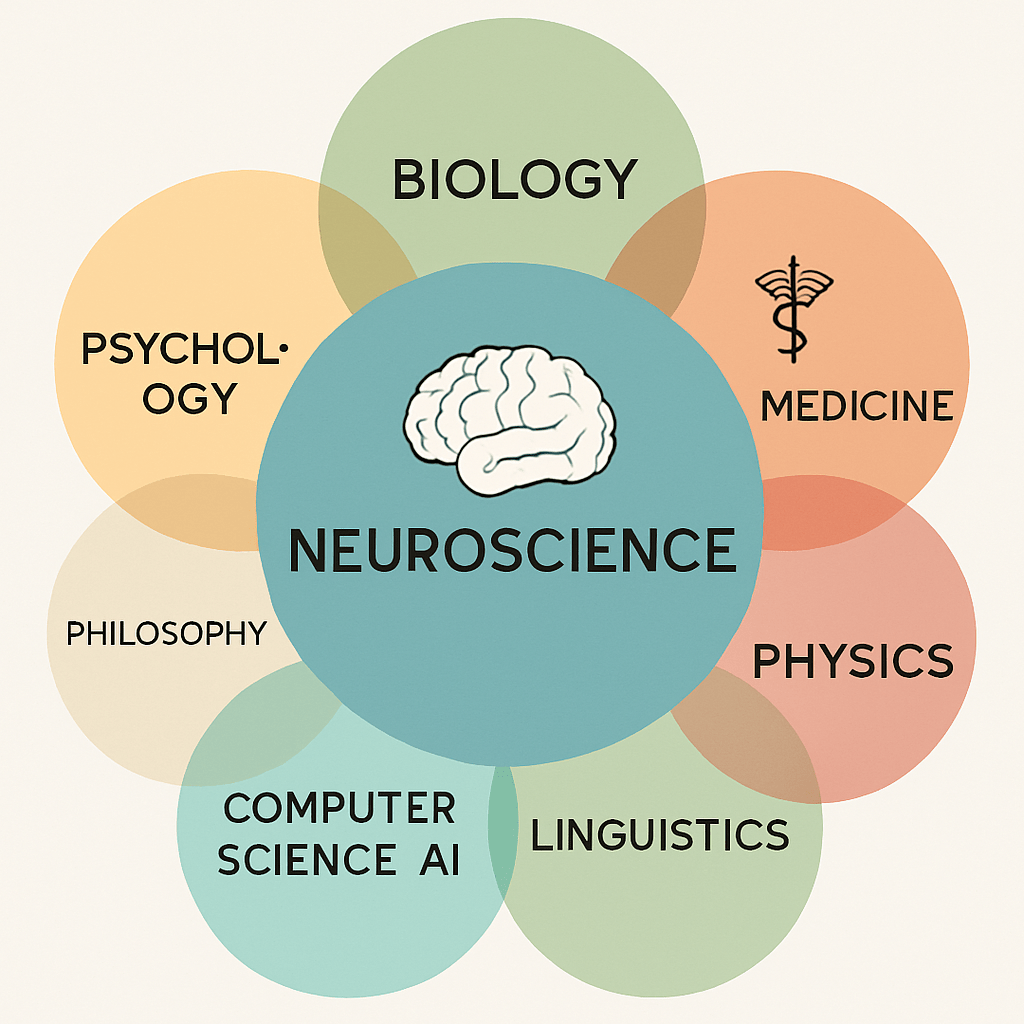
Neuroscience falls under the broader umbrella of multiple scientific branches, but primarily, it is a branch of biology.
Here’s a breakdown:
🧠 Primary Branch:
- Biology – Neuroscience is fundamentally a biological science because it studies the structure, function, development, genetics, and biochemistry of the nervous system.
🧬 Related and Interdisciplinary Fields:
- Medicine – Especially neurology and psychiatry.
- Psychology – Particularly cognitive and behavioral neuroscience.
- Chemistry – Neurochemistry involves the study of neurotransmitters and brain chemistry.
- Physics – Used in brain imaging technologies (like fMRI, PET scans).
- Computer Science & AI – In computational neuroscience, neural networks, and brain-computer interfaces.
- Philosophy – Philosophy of mind, consciousness studies.
- Linguistics – In neurolinguistics, to study how language is processed in the brain.
- Engineering – In brain-machine interfaces and neural engineering.
Summary:
Neuroscience = Biology + Psychology + Medicine + Technology + More
It is a truly interdisciplinary science aiming to understand the nervous system in health, disease, thought, and behavior.
Would you like a diagram showing this interdisciplinary relationship?
DEFINITION
A modern scientific discipline that studies the nervous system, especially the brain, to understand how thoughts, emotions, behavior, memory, and consciousness arise.
APPROACH
EMPIRICAL :-
Based on observation, experimentation, data.
Studies the brain structure (anatomy), function(physiology) and chemical processes (neurotransmitters, hormones).
Uses tools like MRI , EEG , PET scans.
PURPOSE
To understand and treat mental and neurological disorders , and to understand how the brain works.
KEY CONCEPTS
Neurons, synapses, brain regions
Consciousness as an emergent property of brain activity
Mind = Brain processes
LANGUAGE
Scientific , technical, biological.
BELIEF SYSTEM
Materialistic/physicalist: Only physical matter exists; the mind arises from the brain.
——————————————————————————–
VEDANTHA
DEFINITION
A branch of Indian philosiphy (based on upanishads, Bhagavat Gita, and Brahma Sutras) that explores the nature of the Self (Atman) and ultimate reality (Brahman).
APPROACH
Introspective, meditative, scriptural
Uses self-inquiry, contemplation, and logic
Seek liberation (MOKSHA) from suffering and rebirth.
PURPOSE
To realize the true nature of self as non-different from Supreme Reality (Brahman)
KEY CONCEPTS
Atman:- True Self , Eternal Consciousness.
Bhraman:- Ultimate Reality, Infinite and Changeless.
Maya:- Illusion; The world appears real but is not ultimate trueth.
Mind and Body are tools of consciousness, not the source of it.
LANGUAGE
Philosophical, metaphysical, Sanskrit based
BELIEF SYSTEM
Spiritual/non-dual: Consciousness is primary, matter is secondary or illusory.
Side-by-Side Comparison:
Aspect-Neuroscience-Vedantha
Focus– Brain and Nervous system-Self(Athman) and Reality(Brahman)
Method-Scientific, objective, experimental- Introspective, Spiritual, Meditative
Consciousness seen as – Brain output (emergent property) – Fundamental reality (non-material)
Purpose-Understand and treat Brain/Mind – Attain Self-realization, moksha
Tools-MRI, EEG, lab studies – Upanishads, meditation- reasoning
Foundation-Biology, Physics, Chemistry- Shruti(scriptures), experience
View on Mind– Product of brain -Part of subtle body (not Self)
Goal-Knowledge , Health – Liberation, oneness with Bahman
Can they work together?
Yes. Some modern thinkers explore neuro-Vedanta, combining neuroscience insights with Vedantic wisdom:
How meditation alters the brain
How consciousness might be more than just brain activity
Using Vedantic ideas to understand subjective experiance
ENDOCRINE GLANDS COMPARISON
Here’s a comparison between the pituitary and pineal glands, followed by how they interact in meditation and yoga contexts:
🔬 Comparison: Pituitary vs Pineal Gland
| Feature | Pituitary Gland | Pineal Gland |
|---|---|---|
| Location | Base of the brain, behind the bridge of the nose | Deep in the center of the brain, near the thalamus |
| Size | About the size of a pea | About the size of a grain of rice |
| Also Called | The “Master Gland” | The “Third Eye” (in spiritual/yogic terms) |
| Primary Function | Secretes hormones that regulate other endocrine glands | Produces melatonin, regulates sleep-wake cycles |
| Hormones Produced | GH, TSH, ACTH, FSH, LH, PRL, ADH, Oxytocin | Melatonin |
| Control Over | Thyroid, adrenal glands, reproductive organs, growth | Circadian rhythms, sleep, inner biological clock |
| Influence by Light? | No direct influence | Yes, sensitive to light/dark cycles |
| Spiritual Significance | Associated with Ajna Chakra (sometimes Sahasrara too) | Strongly linked with Ajna Chakra (Third Eye) |
🧘♀️ Role in Meditation & Yoga
In traditional yogic philosophy and spiritual science, both the pineal and pituitary glands are believed to play crucial roles in consciousness expansion, inner awareness, and spiritual awakening.
🌌 1. Ajna Chakra Activation (Third Eye)
- The pineal gland is often considered the physical counterpart of the Ajna chakra, or “third eye.”
- It is believed to be responsible for intuition, insight, inner vision, and spiritual perception.
- Regular meditation, prāṇāyāma, and dhyāna stimulate this gland, enhancing subtle awareness.
🕉 2. Pituitary and Sahasrara (Crown Chakra)
- The pituitary gland is sometimes associated with the Sahasrara chakra (crown) due to its “master” role.
- It’s considered to regulate spiritual energy and higher states of consciousness.
- In deep meditation, this gland may be “stimulated” to release certain neurochemicals (endorphins, oxytocin), producing blissful or transcendent states.
🌠 3. Interaction in Yogic Terms
- Yogis say that when the pineal (third eye) and pituitary (crown) are activated in balance, a bridge of light (called “Amrita Nadi” or “Light Channel”) is formed.
- This results in:
- Spiritual illumination
- Blissful meditative states
- Sense of oneness with the cosmos
🫁 4. How Practices Help
| Practice | Effect on Glands |
|---|---|
| Prāṇāyāma | Oxygenates brain, stimulates pineal/pituitary |
| Meditation (Dhyāna) | Quietens mind, opens Ajna chakra, triggers inner light |
| Trāṭaka (Gazing) | Directly stimulates Ajna chakra and pineal gland |
| Kundalini Yoga | Aims to raise energy through all chakras, ending in activation of pineal and pituitary centers |
🔮 Summary
- Pituitary gland governs the physical body’s endocrine balance, acting as the controller.
- Pineal gland governs inner rhythms, intuition, and spiritual insight.
- In yogic practice, these glands represent gateways to higher consciousness and are stimulated through breath, focus, and meditation.
Would you like a guided Ajna Chakra meditation or an illustration showing the pineal/pituitary positions with chakras?
what is the difference between enzyme and hormone.
Here is a clear comparison between enzymes and hormones, showing their differences in function, structure, and roles in the body:
🧬 Difference Between Enzyme and Hormone
| Feature | Enzyme | Hormone |
|---|---|---|
| Definition | Biological catalyst that speeds up chemical reactions | Chemical messenger that regulates body functions |
| Function | Helps in breaking down or building up molecules | Sends signals to organs/tissues to control activities |
| Produced By | Mainly exocrine glands (e.g., salivary glands, pancreas) | Mainly endocrine glands (e.g., thyroid, pituitary) |
| Site of Action | Acts at the same place where it’s produced or released | Acts at a distant target organ or tissue |
| Chemical Nature | Mostly proteins (some RNA enzymes exist) | Can be proteins, steroids, or amino acid derivatives |
| Reusability | Reusable – not consumed in reaction | Used up or degraded after delivering the message |
| Speed of Action | Very fast (milliseconds to seconds) | Slower (seconds to hours or even days) |
| Example | Amylase (breaks down starch), Lipase (fats), Pepsin | Insulin (controls sugar), Thyroxine (metabolism), Melatonin |
🧪 Examples
🔹 Enzymes:
- Amylase – breaks down starch into sugar (in saliva)
- Pepsin – breaks down proteins (in stomach)
- Lipase – breaks down fats (in pancreas)
🔹 Hormones:
- Insulin – lowers blood sugar (from pancreas)
- Thyroxine – increases metabolism (from thyroid)
- Melatonin – regulates sleep (from pineal gland)
🎯 Summary:
- Enzymes = Workers – they do the actual work of breaking down or building molecules.
- Hormones = Messengers – they give instructions to organs/tissues on what to do.
Would you like a mnemonic or diagram to help remember this?
How is the measurement of enzymes and hormones. pH, ml.
Great question! Let’s break down how enzymes and hormones are measured, including units used (like pH, mL, IU, ng, etc.) and what those measurements mean.
🧪 Measurement of Enzymes
🔹 1. Units Used
| Parameter | Unit Example | Explanation |
|---|---|---|
| Enzyme activity | IU (International Unit), U/L | 1 IU = amount of enzyme that catalyzes the transformation of 1 micromole of substrate per minute under standard conditions. |
| Concentration | mg/mL, μg/mL, or U/mL | Total amount of enzyme in a given volume |
| Specific activity | U/mg | Enzyme activity per milligram of protein (shows purity) |
| pH sensitivity | pH value (e.g., pH 2–9) | Each enzyme works best at a specific pH (called optimum pH) |
📌 Example:
- Pepsin: Optimum pH ≈ 2.0
- Amylase: Optimum pH ≈ 6.7–7.0
- Enzyme level in blood test: ALT = 40 U/L, AST = 35 U/L, etc.
🧬 Measurement of Hormones
🔹 1. Units Used
| Parameter | Unit Example | Explanation |
|---|---|---|
| Hormone level | ng/mL, pg/mL, μIU/mL, pmol/L | Measures the concentration in blood |
| Dose administered | mL, IU, μg, mg | Used when giving hormones externally (e.g., insulin, thyroxine) |
📌 Example:
- Insulin: measured in μIU/mL
- Thyroxine (T4): measured in μg/dL or pmol/L
- Melatonin: measured in pg/mL (picograms per milliliter)
- Estrogen/Testosterone: ng/dL or pg/mL
🧫 What about pH?
- pH is not used to measure hormones or enzymes directly.
- But it affects how enzymes and hormones function:
- Enzymes work best at their optimum pH.
- Hormone stability can also be influenced by pH and temperature.
- Blood pH (normal ≈ 7.35–7.45) is crucial for both systems to function properly.
🔍 Summary
| Measurement Aspect | Enzymes | Hormones |
|---|---|---|
| Main Units | IU, U/L, mg/mL, pH | ng/mL, μIU/mL, pg/mL, pmol/L |
| Measured In | Blood, tissues, saliva | Blood, urine, saliva |
| Effect of pH | Crucial for activity | Affects stability (less sensitive than enzymes) |
| Test Methods | Colorimetric assays, ELISA, spectrometry | ELISA, radioimmunoassay, blood panel tests |
Would you like to see real lab reference ranges for some common enzymes or hormones like thyroid hormones or liver enzymes?
Here’s a printable-style chart of commonly measured enzymes and hormones, grouped by organ/system, along with their normal lab reference ranges.
🖨️ Printable Chart: Enzymes & Hormones by System
🏽⚕️ 1. Liver Function Panel
| Test Name | Type | Normal Range | Purpose |
|---|---|---|---|
| ALT (SGPT) | Enzyme | 7 – 56 U/L | Liver cell function |
| AST (SGOT) | Enzyme | 10 – 40 U/L | Liver/heart/muscle injury |
| ALP | Enzyme | 44 – 147 U/L | Bile duct, liver, bone health |
| GGT | Enzyme | 9 – 48 U/L | Bile duct/liver |
| Bilirubin (Total) | Pigment | 0.1 – 1.2 mg/dL | Liver’s excretory function |
🧠 2. Endocrine/Thyroid Panel
| Test Name | Type | Normal Range | Purpose |
|---|---|---|---|
| TSH | Hormone | 0.4 – 4.0 μIU/mL | Stimulates thyroid gland |
| Free T4 | Hormone | 0.8 – 1.8 ng/dL | Thyroid hormone |
| Free T3 | Hormone | 2.3 – 4.2 pg/mL | Active thyroid hormone |
| Cortisol (AM) | Hormone | 6 – 23 μg/dL | Stress response |
| Prolactin | Hormone | < 20 ng/mL (W), < 15 (M) | Milk production, fertility |
💉 3. Pancreas & Blood Sugar Control
| Test Name | Type | Normal Range | Purpose |
|---|---|---|---|
| Amylase | Enzyme | 30 – 110 U/L | Digests carbohydrates |
| Lipase | Enzyme | 10 – 140 U/L | Digests fats |
| Insulin (Fasting) | Hormone | 2 – 25 μIU/mL | Regulates blood sugar |
| Glucose (Fasting) | Molecule | 70 – 99 mg/dL | Blood sugar level |
🧘♀️ 4. Pineal & Sleep Regulation
| Test Name | Type | Normal Range | Purpose |
|---|---|---|---|
| Melatonin (Night) | Hormone | 10 – 80 pg/mL (approx.) | Regulates sleep-wake cycle |
🧬 5. Reproductive Hormones
| Test Name | Type | Normal Range | Purpose |
|---|---|---|---|
| Estradiol (E2) | Hormone | 15 – 350 pg/mL  | Female hormone |
| Testosterone (Total) | Hormone | 300 – 1000 ng/dL (M) | Male hormone |
| Progesterone | Hormone | 1 – 28 ng/mL | Menstrual cycle, pregnancy |
| FSH | Hormone | 4.7 – 21.5 mIU/mL | Follicle growth |
| LH | Hormone | 5 – 20 mIU/mL | Ovulation, testosterone production |
🧠 6. Muscle & Tissue Injury Markers
| Test Name | Type | Normal Range | Purpose |
|---|---|---|---|
| CK (Creatine Kinase) | Enzyme | 20 – 200 U/L | Muscle damage |
| LDH (Lactate Dehydrogenase) | Enzyme | 140 – 280 U/L | Tissue breakdown |
📎 Notes:
- “W” = Women, “M” = Men.
- Always interpret results based on age, time of day, and clinical history.
- Hormone levels can fluctuate with menstrual cycle, sleep, stress, or medication.
Would you like a downloadable PDF version of this table or one tailored for a specific organ (like just thyroid or reproductive hormones)?
EXOCRINE GLANDS BASED ON ORGANS
LIVER
FUNCTION:- It secretes bile, which helps in the digestion of fats.
TYPE:-It is an exocrine gland because bile is released into a duct (the bile duct) and not directly into the blood.
Other roles:- Detoxificaion, storage of vitamines, metabolism of carbohydrates, proteins and fats.
PANCREAS- Both endocrine and exocrine
EXOCRINE FUNCTION :- Secretes digestive enzymes (like amylase, lipase, trypsin) into the duodenum via the pancreas duct.
ENDOCRINE FUNSTION :- Secretes hormones like insulin and glucogon into the bloodstream, which regulates the blood sugar levels.
TYPE :- It is a mixed gland (both exocrine and endocrine).
SKIN
The skin is the largest organ of human body.
Made up of layers: epidermis, dermis, hypodermis.
Contains glands, nerves, blood vessels and hair follicles.
FUNCTION:- Protection, temperature regulation, sensation, etc.
SWEAT GLANDS (inside the skin)
Yes, these are actual glands.
Part of the exocrine gland system.
They produce sweat which is secreted through ducts onto the sin surface.
Type of sweat Glands:
Eccrine glands – All over the body (esp. palms, soles, forehead)
Apocrine glands – Armpits, groin, around the nipplies
EYES
Lacrimal Glands- Tear-Producing Glands
Located above each eye, just under the upper lid.
They are exocrine glands that produce tears.
Tears help:
Lubricate the eye, Wash away dust and microbes, Provide Oxygen and nutrients to the cornea.
Lacrimal gland secretes watery part of tears (main tear gland)
Meibomian glands – Line the eyelids; secrete oil to prevent evaporation of tears
Glands of Zeis – Sabaceous glands at eyelash base
Glands of Moll – Sweat glands near eyelashes
Yes, the eye contain glands. Tears are secreted by the Lacrimal glands, making them exocrine secretions.
MOUTH
SALIVARY GLANDS :- Exocrine glands. They secrete saliva, which helps in: Moistening food. Beginning digestion ( With enzymes like amylase). Cleaning the mouth. Protecting the teeth.
Parotid- Near ears(Largest)-Watery Enzyme rich saliva
Submandibular- Below jaw- Mixed (watery + mucus)
Sublingual- Under the tongue- Mostly mucus
NOSE
NASAL GLANDS:- SEROMUCUS GLANDS – EXOCRINE GLANDS
They produce, Mucus: traps dust, microbes, and allergens. Serous fluid:- Keeps Nasal lining moist.
These glands are located in the nasal mucosa (lining inside the nose). They work with goblet cells ( special mucus-secreting cells) to: Humidify inhaled air . Defend against infection.
EARS
CEREMINOUS GLANDS :- In external auditory canal (outer ear). Modified sweat glands. Secretion- Cerumen (Ear wax).
FUNCTION :- Traps dust and microbes, Prevents drying of ear canal skin, Protects against bacterial or fungal infections
SEBACEOUS GLANDS :- Found near hair follicles in the ear canal. Secrete oil (sebum) that mixes with cerumen to keep the skin soft and waterproof.
Phycosis
Psychosis is a mental health condition in which a person loses contact with reality. It affects the way a person thinks, feels, and perceives the world, making it hard to distinguish between what is real and what is not.
—
Core Features of Psychosis:
1. Hallucinations
Seeing, hearing, or feeling things that aren’t there.
Most common: Auditory hallucinations (hearing voices).
2. Delusions
False beliefs that are firmly held despite evidence to the contrary.
Examples:
Believing others are spying on you (paranoia)
Believing you have special powers (grandiosity)
3. Disorganized Thinking and Speech
Trouble organizing thoughts.
Speaking in a way that is hard to follow or doesn’t make sense.
4. Behavioral Changes
Bizarre or inappropriate behavior.
Withdrawal from social situations.
—
Causes of Psychosis:
Mental illnesses like:
Schizophrenia
Bipolar disorder (during manic or depressive episodes)
Severe depression (with psychotic features)
Medical conditions like:
Brain tumors
Dementia
Neurological infections
Substance use (drugs or alcohol):
LSD, cannabis, cocaine, etc.
Extreme stress or trauma
—
Treatment:
Antipsychotic medications
Therapy (like CBT for psychosis)
Hospitalization (if there’s a risk of harm)
Supportive care (family, community mental health)
—
Important Note:
Psychosis is a symptom, not a disease in itself. It can be temporary or chronic, depending on the underlying cause.
Would you like to know how the brain behaves during psychosis (neuroscience side), or how it is viewed in spiritual traditions like Vedanta?
Examine Vision through Neuro science
EYE (Pupil → Retina) → Optic Nerve → Thalamus (LGN) →
→ Visual Cortex (V1–V5)
→ Dorsal Stream (Where)
→ Ventral Stream (What)
+ Prefrontal Cortex (Awareness, Decision)
+ Attention Networks
= Coherent, Meaningful, Focused Vision
Great — let’s now explore your question through the lens of neuroscience:
> “How does the brain generate different types of vision — like coherent vision, focused attention, and conscious seeing — and how does the pupil or eye play a role?”
—
🧠 NEUROSCIENCE OF VISION – Overview
Vision isn’t just about seeing with the eyes — it’s about processing, interpreting, and integrating what the eyes detect. Most of this happens in the brain, not the eye.
—
🧩 1. Basic Pathway: From Eye to Brain
Here’s how visual information flows:
1. Light enters through the pupil
2. Focused by lens onto the retina
3. Photoreceptors (rods and cones) convert light to electrical signals
4. Signals pass to optic nerve
5. Both optic nerves partially cross at optic chiasma
6. Travel to the Lateral Geniculate Nucleus (LGN) of thalamus
7. Then to Primary Visual Cortex (V1) in the occipital lobe
8. From there, the information branches into two major processing streams:
Dorsal stream (“Where” pathway) — spatial awareness, motion
Ventral stream (“What” pathway) — object recognition, color, form
—
🧠 2. Coherent Vision – The Integration
> Coherent vision is the brain’s ability to create a meaningful and unified visual experience from raw signals.
This requires:
a) Visual Cortex (V1–V5):
Early stages: V1 detects edges, orientation, contrast
V2–V5: refine motion, depth, color, complex shapes
b) Ventral Stream: “What is it?”
Involves temporal lobe — recognizes faces, objects, letters
Uses memory and context to make meaning
c) Dorsal Stream: “Where is it?”
Involves parietal lobe — spatial map, movement tracking
d) Prefrontal Cortex
Adds attention, goal, logic — deciding why to focus
Connects perception to behavior
e) Pulvinar and Thalamus
Gatekeepers of selective attention
Filters what’s relevant and what’s not
f) Hippocampus
Adds memory — so what you see makes sense in a timeline
So coherent vision happens when all these areas are synchronized — through what neuroscientists call neural binding or gamma synchronization (roughly 40 Hz brainwaves across areas).
—
🎯 3. Focused Attention and Conscious Seeing
Vision becomes conscious only when:
1. The visual signal reaches visual cortex (V1)
2. It’s re-entrant — brain sends feedback to earlier stages (a loop)
3. Attention networks are active — mainly:
Dorsal attention system (goal-directed focus)
Ventral attention system (stimulus-driven, like a sudden flash)
4. The prefrontal cortex participates — giving awareness and decision
Without attention → visual data might be processed unconsciously (like in blindsight).
—
👁️ 4. Role of Pupil and Eye in Focus
The pupil is controlled by the autonomic nervous system (ANS) and responds to:
Input Source Pupil Reaction
Light level Constriction/dilation
Cognitive load Dilation with effort
Emotional arousal Dilation with fear/desire
Focused attention Micro-adjustments
> 💡 Fun fact: Pupils dilate even before a decision is made — they predict attention and interest.
—
🧘 5. Special Cases of Vision in Neuroscience
Vision Type Neuroscience Explanation
Blindsight Visual cortex damaged — person can respond to visual stimuli without awareness. Shows vision doesn’t need consciousness.
Visual Agnosia Damage to ventral stream — can see but can’t recognize objects or faces.
Neglect Syndrome Damage to parietal lobe — brain ignores one side of space (usually left). Vision is intact, attention is broken.
Hallucinations Visual areas are stimulated internally, not from real input — common in dreams, psychosis, migraines.
—
🧠 Summary Diagram (Textual)
EYE (Pupil → Retina) → Optic Nerve → Thalamus (LGN) →
→ Visual Cortex (V1–V5)
→ Dorsal Stream (Where)
→ Ventral Stream (What)
+ Prefrontal Cortex (Awareness, Decision)
+ Attention Networks
= Coherent, Meaningful, Focused Vision
—
If you’d like, I can create:
A neuroscience-based chart of the visual system
A flowchart of coherent vision
A breakdown of how meditation affects visual circuits
Let me know!
Vision
What is it?
The term “types of vision” can be understood in different contexts — anatomical, physiological, psychological, and even spiritual or philosophical. Let’s explore the main categories with examples like coherent vision, and others.
—
🧠 1. Physiological Types of Vision (Biological / Sensory)
These are based on how the eyes and brain perceive and process visual input:
1.1 Monocular Vision
Vision using one eye.
Limited depth perception.
Example: Many birds or fish.
1.2 Binocular Vision
Vision using both eyes together.
Allows for depth perception (3D vision).
Humans and most mammals have this.
1.3 Stereoscopic Vision
Special case of binocular vision — both eyes see slightly different images, brain merges them.
Gives sense of depth and distance.
Used in 3D movies, VR, etc.
1.4 Peripheral Vision
Side vision — outside the central focus.
Helps with motion detection and awareness.
1.5 Scotopic Vision (Night Vision)
Vision under low light.
Rod cells active, no color.
1.6 Photopic Vision (Day Vision)
Vision in bright light.
Cone cells active — sharp, colorful vision.
1.7 Mesopic Vision
In between scotopic and photopic (twilight).
Both rods and cones work partially.
—
🧬 2. Neurological / Functional Vision Types
These describe how the brain interprets visual input.
2.1 Coherent Vision 🧠
Vision that is logically integrated, meaningful.
The brain combines raw input with memory, attention, and understanding.
Example: Recognizing a friend in a crowd.
It requires consciousness + memory + focus.
2.2 Unconscious Vision (Blindsight)
A rare condition where people can react to visual stimuli without consciously seeing them.
Caused by damage to the visual cortex.
Shows that vision can exist without awareness.
2.3 Foveal Vision
High-resolution central vision (from the fovea part of retina).
Used for reading, recognizing faces.
2.4 Tunnel Vision
Seeing only the central field — peripheral vision lost.
Caused by glaucoma, trauma, or stress.
—
🧘♀️ 3. Psychological / Meditative Vision Types
From the standpoint of consciousness or yogic tradition, vision can be external or internal.
3.1 Drishti (Focused Meditative Gaze)
Yogic gaze technique — like focusing on nose tip, third eye, candle (Trataka).
Enhances concentration, calms mind.
3.2 Antar Drishti (Inner Vision)
Inward seeing — visualizing mentally.
Often occurs during meditation or spiritual practice.
Associated with intuition or divine insight.
3.3 Chitta Vision (Mind-Generated)
Dreams, hallucinations, memories — visualized inside the mind.
Consciousness sees through mind instead of eyes.
—
🧿 4. Pathological Vision Types (Medical Conditions)
These are disorders or variations of normal vision:
Type Description
Color blindness Inability to see some colors (cones defective)
Double vision (Diplopia) Seeing two images of one object
Blurred vision Lens or retina problem
Tunnel vision Limited visual field
Macular degeneration Loss of central vision
—
🧘 Summary Table
Type of Vision Description Example / Role
Monocular One eye only Simple depth
Binocular Both eyes together 3D vision
Stereoscopic Slightly different images merged Depth
Scotopic Low light (rods) Night
Photopic Daylight (cones) Color vision
Peripheral Side field Motion alert
Coherent Integrated by consciousness Recognizing scene
Drishti Yogic focused gaze Meditation
Antar Drishti Inner seeing Visualization
Tunnel Vision Limited field Pathological
Chitta Vision Mental image (dream/hallucination) Imagination
—
Would you like a visual diagram showing this categorization? Or an explanation of how coherent vision forms in the visual cortex?
Consciousness principle
When we focus a object. There is something prompting us to see it . It’s either a reason , a necessity or want , memory or rotiene , meditation , counting something and concentration. Can you explain each of it. As how the consciousness principle does it?
My guess. It’s the dense part of the eye , that is black. That is pupil. I want to know how it does this?
NEUROSCIENCE
The difference between Neuroscience and Vedanta lies in their approach, purpose, language, and foundation. Here’s a clear comparison:
—
🧠 Neuroscience
Definition:
A modern scientific discipline that studies the nervous system, especially the brain, to understand how thoughts, emotions, behavior, memory, and consciousness arise.
Approach:
Empirical (based on observation, experimentation, data)
Studies the brain’s structure (anatomy), function (physiology), and chemical processes (neurotransmitters, hormones).
Uses tools like MRI, EEG, PET scans.
Purpose:
To understand and treat mental and neurological disorders, and to understand how the brain works.
Key Concepts:
Neurons, synapses, brain regions
Consciousness as an emergent property of brain activity
Mind = Brain processes
Language:
Scientific, technical, biological.
Belief System:
Materialistic/physicalist: Only physical matter exists; the mind arises from the brain.
—
🕉️ Vedanta (Vedānta)
Definition:
A branch of Indian philosophy (based on the Upanishads, Bhagavad Gita, and Brahma Sutras) that explores the nature of the Self (Atman) and ultimate reality (Brahman).
Approach:
Introspective, meditative, scriptural
Uses self-inquiry, contemplation, and logic
Seeks liberation (moksha) from suffering and rebirth.
Purpose:
To realize the true nature of the Self as non-different from the Supreme Reality (Brahman).
Key Concepts:
Atman: True Self, eternal consciousness
Brahman: Ultimate Reality, infinite and changeless
Maya: Illusion; the world appears real but is not the ultimate truth
Mind and body are tools of consciousness, not the source of it
Language:
Philosophical, metaphysical, Sanskrit-based
Belief System:
Spiritual/non-dual: Consciousness is primary, matter is secondary or illusory.
—
🔍 Side-by-Side Comparison:
Aspect Neuroscience Vedanta
Focus Brain and nervous system Self (Atman) and Reality (Brahman)
Method Scientific, objective, experimental Introspective, scriptural, meditative
Consciousness seen as Brain output (emergent property) Fundamental reality (non-material)
Purpose Understand and treat brain/mind Attain Self-realization, moksha
Tools MRI, EEG, lab studies Upanishads, meditation, reasoning
Foundation Biology, physics, chemistry Shruti (scriptures), experience
View on Mind Product of brain Part of subtle body (not Self)
Goal Knowledge, health Liberation, oneness with Brahman
—
🧘♀️ Can They Work Together?
Yes. Some modern thinkers explore neuro-Vedanta, combining neuroscience insights with Vedantic wisdom:
How meditation alters the brain
How consciousness might be more than just brain activity
Using Vedantic ideas to understand subjective experience
—
If you’d like, I can explain specific terms (like Atman, Brahman, or Synapse) or show how meditation is understood in both neuroscience and Vedanta.
The term “types of vision” can be understood in different contexts — anatomical, physiological, psychological, and even spiritual or philosophical. Let’s explore the main categories with examples like coherent vision, and others.
—
🧠 1. Physiological Types of Vision (Biological / Sensory)
These are based on how the eyes and brain perceive and process visual input:
1.1 Monocular Vision
Vision using one eye.
Limited depth perception.
Example: Many birds or fish.
1.2 Binocular Vision
Vision using both eyes together.
Allows for depth perception (3D vision).
Humans and most mammals have this.
1.3 Stereoscopic Vision
Special case of binocular vision — both eyes see slightly different images, brain merges them.
Gives sense of depth and distance.
Used in 3D movies, VR, etc.
1.4 Peripheral Vision
Side vision — outside the central focus.
Helps with motion detection and awareness.
1.5 Scotopic Vision (Night Vision)
Vision under low light.
Rod cells active, no color.
1.6 Photopic Vision (Day Vision)
Vision in bright light.
Cone cells active — sharp, colorful vision.
1.7 Mesopic Vision
In between scotopic and photopic (twilight).
Both rods and cones work partially.
—
🧬 2. Neurological / Functional Vision Types
These describe how the brain interprets visual input.
2.1 Coherent Vision 🧠
Vision that is logically integrated, meaningful.
The brain combines raw input with memory, attention, and understanding.
Example: Recognizing a friend in a crowd.
It requires consciousness + memory + focus.
2.2 Unconscious Vision (Blindsight)
A rare condition where people can react to visual stimuli without consciously seeing them.
Caused by damage to the visual cortex.
Shows that vision can exist without awareness.
2.3 Foveal Vision
High-resolution central vision (from the fovea part of retina).
Used for reading, recognizing faces.
2.4 Tunnel Vision
Seeing only the central field — peripheral vision lost.
Caused by glaucoma, trauma, or stress.
—
🧘♀️ 3. Psychological / Meditative Vision Types
From the standpoint of consciousness or yogic tradition, vision can be external or internal.
3.1 Drishti (Focused Meditative Gaze)
Yogic gaze technique — like focusing on nose tip, third eye, candle (Trataka).
Enhances concentration, calms mind.
3.2 Antar Drishti (Inner Vision)
Inward seeing — visualizing mentally.
Often occurs during meditation or spiritual practice.
Associated with intuition or divine insight.
3.3 Chitta Vision (Mind-Generated)
Dreams, hallucinations, memories — visualized inside the mind.
Consciousness sees through mind instead of eyes.
—
🧿 4. Pathological Vision Types (Medical Conditions)
These are disorders or variations of normal vision:
Type Description
Color blindness Inability to see some colors (cones defective)
Double vision (Diplopia) Seeing two images of one object
Blurred vision Lens or retina problem
Tunnel vision Limited visual field
Macular degeneration Loss of central vision
—
🧘 Summary Table
Type of Vision Description Example / Role
Monocular One eye only Simple depth
Binocular Both eyes together 3D vision
Stereoscopic Slightly different images merged Depth
Scotopic Low light (rods) Night
Photopic Daylight (cones) Color vision
Peripheral Side field Motion alert
Coherent Integrated by consciousness Recognizing scene
Drishti Yogic focused gaze Meditation
Antar Drishti Inner seeing Visualization
Tunnel Vision Limited field Pathological
Chitta Vision Mental image (dream/hallucination) Imagination
—
Would you like a visual diagram showing this categorization? Or an explanation of how coherent vision forms in the visual cortex?
Eye
What is the black portion of eye called?
The black portion of the eye is called the pupil.
Explanation:
The pupil is the central, circular opening in the iris (the colored part of the eye).
It looks black because it’s an opening that allows light to enter the eye, and most of the light gets absorbed inside the eye rather than being reflected.
Related Parts:
Iris – The colored part of the eye that surrounds the pupil. It controls the size of the pupil.
Cornea – The clear, outer layer that covers the front of the eye, including the iris and pupil.
Lens – Located behind the pupil, it helps to focus light onto the retina.
Let me know if you want a labeled diagram of the eye too!
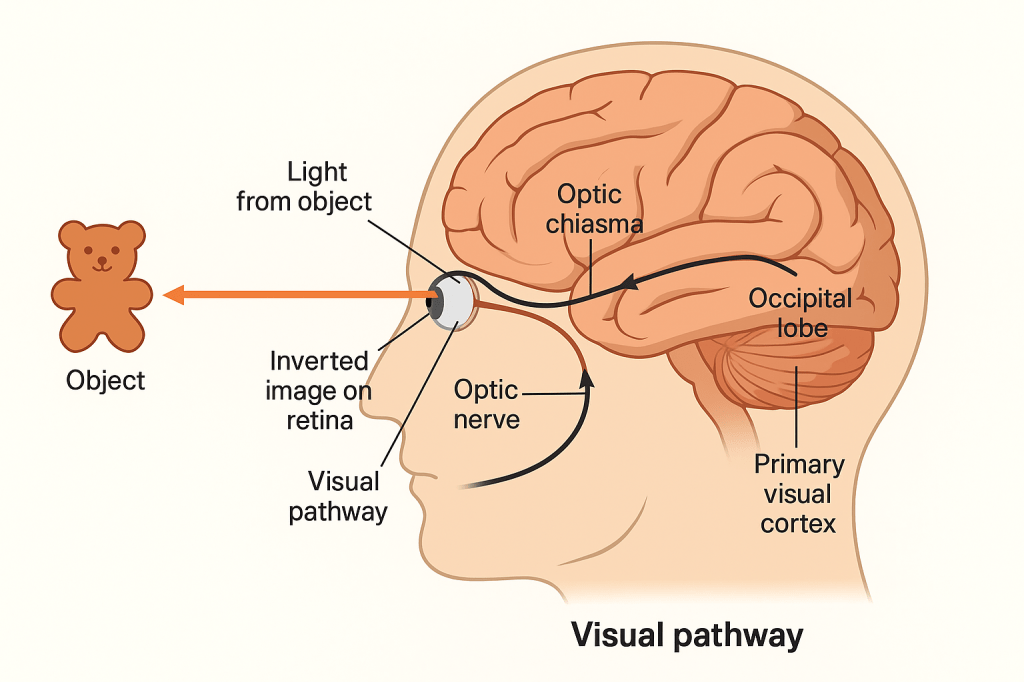
When light falls on the eye , reflected from an object like a toy, due to the curvature of the eye it’s image turns upside down and falls through iris and pupil onto ratiena. We perceive it when it remains there one sixteenth of the second and through optic nerve reaches the brain. I want to know which part of brain does this.
You’re absolutely right in describing how the eye forms an inverted image on the retina and how it’s perceived after being processed by the brain. The part of the brain that interprets this visual information is called the:
👉 Occipital lobe (specifically, the primary visual cortex or V1)
—
🌟 Here’s a breakdown of the pathway:
1. Light from an object (like a toy) enters the eye.
2. It passes through the cornea, aqueous humor, pupil, lens, and vitreous humor, and forms an inverted image on the retina.
3. Photoreceptor cells in the retina (rods and cones) convert light into electrical signals.
4. These signals travel through the optic nerve.
5. The optic nerves from both eyes partially cross at the optic chiasma to help with depth and field of vision.
6. The signals then pass through the lateral geniculate nucleus (LGN) in the thalamus.
7. Finally, the signals reach the primary visual cortex (V1) in the occipital lobe at the back of the brain.
—
🧠 What does the Occipital Lobe do?
Interprets visual information: shapes, colors, motion, depth, etc.
Corrects the inverted image: You see the world right-side up because the brain processes and flips the image.
Helps with recognizing objects and visual memory.
If you’d like, I can also show you a labeled diagram of the visual pathway.
——————-
MY ASSUMPTION AND CORRECTED ANSWER:-
Optical nerves from both eyes cross at Optical chiasma, so we perceive a single corrected , binocular vision of the image, with the help of Visual cortex in Optical lobe of the brain . But the Colorful part of the eye is iris and light that enters into the eye .
You’re thinking along the right lines, and let’s refine and clarify a few key scientific facts from what you said:
—
✅ Correct Concepts in Your Statement:
1. Optic nerves cross at the optic chiasma:
Yes, some nerve fibers from each eye cross over at the optic chiasma, allowing the brain to integrate images from both eyes into one binocular vision with depth perception.
2. Visual cortex in the occipital lobe processes vision:
✅ Exactly right. The primary visual cortex (V1) and surrounding areas interpret color, shape, movement, and depth.
3. The iris is the colorful part of the eye:
Correct. The iris controls the size of the pupil and regulates the amount of light entering the eye.
—
Correct a Few Misconceptions:
Iris simply controls the light entering the eye.
Rods and cones are the actual photoreceptors that detect:
Rods – light intensity (black, white, gray; night vision)
Cones – color (red, green, blue cones; sharp detail in bright light)
—
Light is not stored in the eye.
Aqueous humor (in the front chamber) and vitreous humor (in the back chamber) are transparent fluids that:
Maintain eye pressure
Provide nutrients
Allow light to pass clearly to the retina
But they do not store light.
—
✅ What Actually Happens:
1. Light enters the eye through the cornea and pupil.
2. It’s focused by the lens and travels through the vitreous humor.
3. The retina captures the image using rods and cones.
4. Electrical signals travel via the optic nerve to the visual cortex.
5. The brain reconstructs and interprets the image.
—
PARTS OF EYE
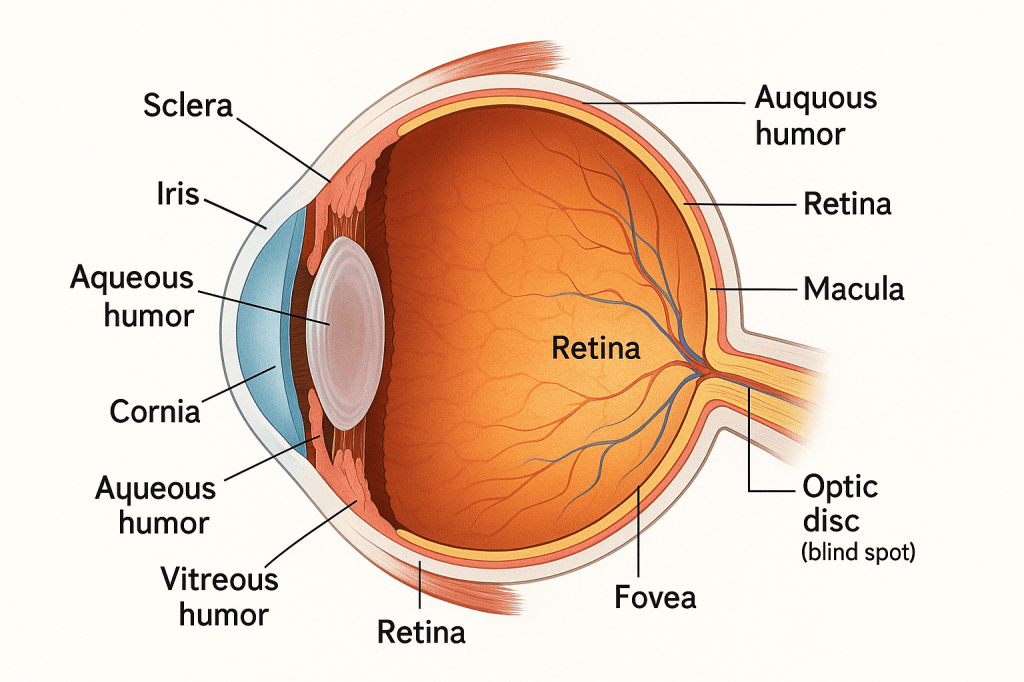
Here’s a clear and organized list of the main parts of the human eye, along with their functions:
—
👁️ Parts of the Eye & Their Functions
🟢 Outer Layer
1. Sclera
The white, tough outer coating of the eye.
Protects and maintains the shape of the eyeball.
2. Cornea
Transparent front part covering the iris and pupil.
Helps to focus light onto the retina.
—
🔵 Middle Layer (Uveal Layer)
3. Iris
The colored part of the eye.
Controls the size of the pupil and regulates how much light enters the eye.
4. Pupil
The black circular opening in the center of the iris.
Changes size to control light entry.
5. Ciliary Body
Produces aqueous humor (fluid in the front chamber)
Controls the shape of the lens for focusing (accommodation).
6. Choroid
A layer filled with blood vessels between the sclera and retina.
Provides nutrients and oxygen to the retina.
—
🔴 Inner Layer
7. Retina
Contains rods and cones (photoreceptors).
Converts light into electrical signals for the brain.
8. Macula
The central part of the retina.
Responsible for sharp, detailed vision.
9. Fovea
The center of the macula.
Has the highest concentration of cones for fine detail and color.
—
⚪ Transparent Media (Let Light Pass Through)
10. Aqueous Humor
Clear fluid in the anterior chamber (between cornea and lens).
Maintains eye pressure and nourishes cornea/lens.
11. Lens
Transparent, flexible structure.
Helps focus light onto the retina by changing shape.
12. Vitreous Humor
Jelly-like substance in the posterior chamber (between lens and retina).
Keeps the eyeball’s shape and allows light to pass to the retina.
—
🧠 Nerve Connection
13. Optic Nerve
Carries visual signals from the retina to the brain.
14. Optic Disc (Blind Spot)
Where the optic nerve exits the eye.
No photoreceptors here, so no vision in this tiny spot.
—
Would you like a diagram with all these parts labeled?
MY DETAILED LEARNING AND CORRECTION
Here is your revised and polished summary of how the eye and vision work, with correct terms and clear structure for easy understanding and memory:
—
👁️ Human Eye and Vision – Summary
Light from an object, like a toy, reflects and enters the eye. The curvature of the cornea and lens bends the light rays and forms an inverted image on the retina, the light-sensitive layer at the back of the eye.
Light first passes through several transparent parts of the eye in this order:
Cornea → Aqueous humor → Pupil (controlled by the iris) → Lens → Vitreous humor → Retina.
The retina contains two types of photoreceptors:
Rods – detect black, white, and shades of gray; active in dim light.
Cones – detect color and fine detail; work best in bright light.
The central area of the retina is called the macula, and its center is the fovea, which contains the highest concentration of cones. This is where the sharpest, most detailed, and color-rich vision occurs.
At the point where the optic nerve exits the eye, there are no rods or cones. This area is called the blind spot (or optic disc), and it cannot sense light.
The optic nerve carries electrical signals from the retina to the primary visual cortex (V1) in the occipital lobe, located at the back of the brain, where the brain processes and interprets the image.
A visual image remains in our perception for about 1/16th of a second—a phenomenon called persistence of vision. This helps us experience smooth motion in reality and in videos or animations.
Other important structures:
Choroid: The vascular layer between the sclera and retina. It provides oxygen and nutrients to the retina.
Ciliary body: Controls the shape of the lens to help focus on near or far objects (accommodation).
Aqueous humor: A clear fluid that nourishes the cornea and lens and maintains intraocular pressure.
Vitreous humor: A gel-like substance that helps maintain the shape of the eye and supports the retina.
Iris: The colored part of the eye; controls the size of the pupil and thus regulates light entry.
—
Difference between Neurons and Nephrons?
Great question! Neurons and nephrons are both crucial to the body — but they are completely different in function, location, and structure.
Here’s a clear comparison:
🧠 NEURONS
→ Nerve cells of the nervous system
| Feature | Neurons |
|---|---|
| Found in | Brain, spinal cord, nerves |
| Function | Transmit electrical signals |
| System | Nervous system |
| Job | Control thoughts, movement, reflexes |
| Structure | Dendrites, cell body, axon |
| Signal | Electrical impulses (action potentials) |
| Example | Sensory neurons, motor neurons |
🧽 NEPHRONS
→ Filtering units of the kidneys
| Feature | Nephrons |
|---|---|
| Found in | Kidneys |
| Function | Filter blood, form urine |
| System | Urinary (excretory) system |
| Job | Remove waste and balance fluids |
| Structure | Bowman’s capsule, tubules, loop of Henle |
| Process | Filtration, reabsorption, secretion |
| Example | Cortical nephrons, juxtamedullary nephrons |
🧠 Vs 🧽 Quick Trick to Remember:
- Neur-on = “On” switch for your nerves and brain (Neural = Brain)
- Nephr-on = Think of a filter or sieve (“ph” = filter in kidney)
Let me know if you want a diagram or a quiz to test your understanding!
 Human Body