NEUROSCIENCE
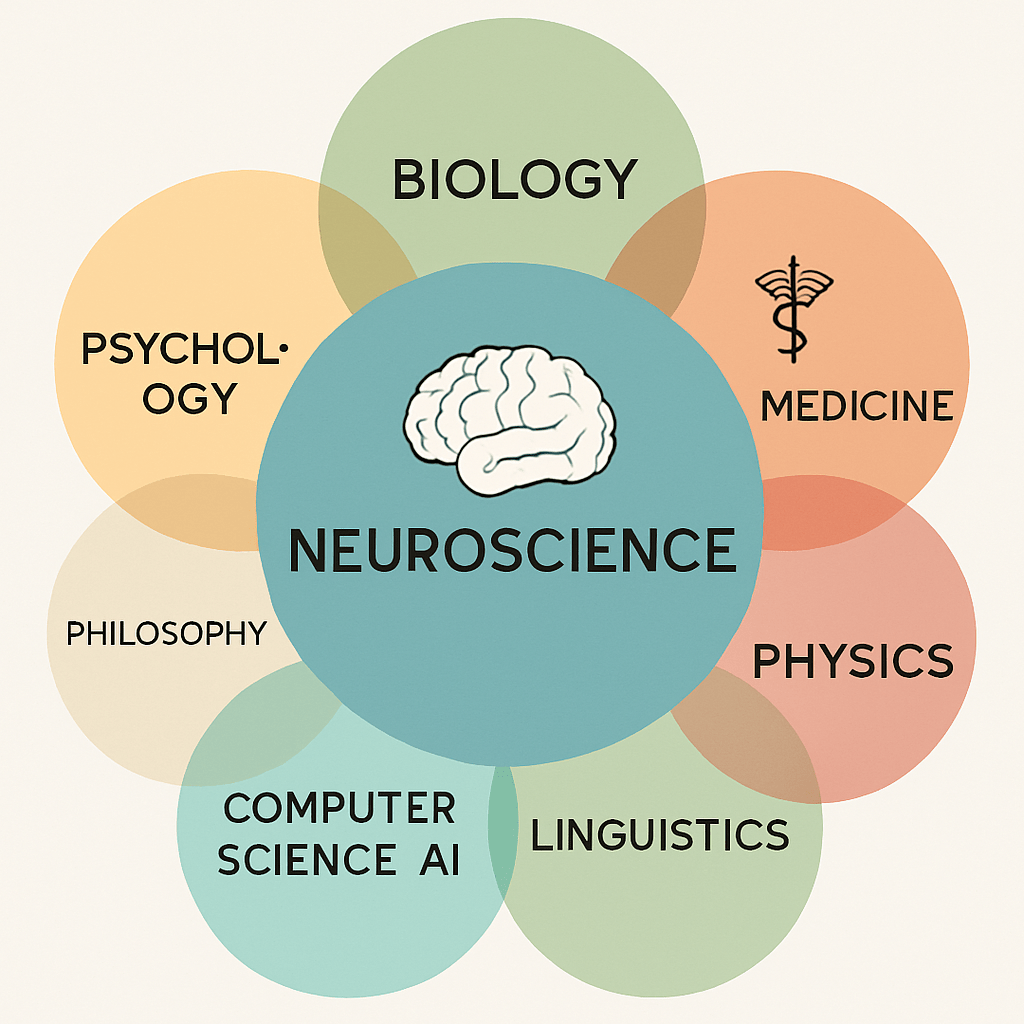
Neuroscience falls under the broader umbrella of multiple scientific branches, but primarily, it is a branch of biology.
Here’s a breakdown:
🧠 Primary Branch:
- Biology – Neuroscience is fundamentally a biological science because it studies the structure, function, development, genetics, and biochemistry of the nervous system.
🧬 Related and Interdisciplinary Fields:
- Medicine – Especially neurology and psychiatry.
- Psychology – Particularly cognitive and behavioral neuroscience.
- Chemistry – Neurochemistry involves the study of neurotransmitters and brain chemistry.
- Physics – Used in brain imaging technologies (like fMRI, PET scans).
- Computer Science & AI – In computational neuroscience, neural networks, and brain-computer interfaces.
- Philosophy – Philosophy of mind, consciousness studies.
- Linguistics – In neurolinguistics, to study how language is processed in the brain.
- Engineering – In brain-machine interfaces and neural engineering.
Summary:
Neuroscience = Biology + Psychology + Medicine + Technology + More
It is a truly interdisciplinary science aiming to understand the nervous system in health, disease, thought, and behavior.
Would you like a diagram showing this interdisciplinary relationship?
DEFINITION
A modern scientific discipline that studies the nervous system, especially the brain, to understand how thoughts, emotions, behavior, memory, and consciousness arise.
APPROACH
EMPIRICAL :-
Based on observation, experimentation, data.
Studies the brain structure (anatomy), function(physiology) and chemical processes (neurotransmitters, hormones).
Uses tools like MRI , EEG , PET scans.
PURPOSE
To understand and treat mental and neurological disorders , and to understand how the brain works.
KEY CONCEPTS
Neurons, synapses, brain regions
Consciousness as an emergent property of brain activity
Mind = Brain processes
LANGUAGE
Scientific , technical, biological.
BELIEF SYSTEM
Materialistic/physicalist: Only physical matter exists; the mind arises from the brain.
——————————————————————————–
VEDANTHA
DEFINITION
A branch of Indian philosiphy (based on upanishads, Bhagavat Gita, and Brahma Sutras) that explores the nature of the Self (Atman) and ultimate reality (Brahman).
APPROACH
Introspective, meditative, scriptural
Uses self-inquiry, contemplation, and logic
Seek liberation (MOKSHA) from suffering and rebirth.
PURPOSE
To realize the true nature of self as non-different from Supreme Reality (Brahman)
KEY CONCEPTS
Atman:- True Self , Eternal Consciousness.
Bhraman:- Ultimate Reality, Infinite and Changeless.
Maya:- Illusion; The world appears real but is not ultimate trueth.
Mind and Body are tools of consciousness, not the source of it.
LANGUAGE
Philosophical, metaphysical, Sanskrit based
BELIEF SYSTEM
Spiritual/non-dual: Consciousness is primary, matter is secondary or illusory.
Side-by-Side Comparison:
Aspect-Neuroscience-Vedantha
Focus– Brain and Nervous system-Self(Athman) and Reality(Brahman)
Method-Scientific, objective, experimental- Introspective, Spiritual, Meditative
Consciousness seen as – Brain output (emergent property) – Fundamental reality (non-material)
Purpose-Understand and treat Brain/Mind – Attain Self-realization, moksha
Tools-MRI, EEG, lab studies – Upanishads, meditation- reasoning
Foundation-Biology, Physics, Chemistry- Shruti(scriptures), experience
View on Mind– Product of brain -Part of subtle body (not Self)
Goal-Knowledge , Health – Liberation, oneness with Bahman
Can they work together?
Yes. Some modern thinkers explore neuro-Vedanta, combining neuroscience insights with Vedantic wisdom:
How meditation alters the brain
How consciousness might be more than just brain activity
Using Vedantic ideas to understand subjective experiance
 Human Body